The Long, Difficult Trail to the White House
By Jeff Knoll
When President Donald Trump signed the Executive Order Removing Unnecessary and Counterproductive Restrictions on Access to Federal Lands on May 29, 2026, most observers saw a political event. Supporters celebrated. Critics objected. Pundits did what pundits do. The headlines focused on the White House and the implications for millions of acres of federal land across the American West.
What received far less attention was the journey that brought the issue to the President's desk in the first place.
The Executive Order did not emerge from nowhere. It was not the product of a single meeting, a single election, or a single administration. The story spans more than half a century, through three presidential administrations, countless public lands battles, and a decade-long grassroots effort led by a coalition of recreation advocates who eventually decided to challenge assumptions most people had long accepted as permanent.
To understand why the Trump Administration withdrew Executive Orders 11644 and 11989, it helps to understand why those orders existed in the first place.
On February 8, 1972, President Richard Nixon signed Executive Order 11644, establishing federal policy for the management of off-road vehicles on public lands. America was experiencing the early years of the environmental movement. Earth Day had only recently entered the national consciousness. New generations of motorcycles, Jeeps, snowmobiles, and off-road vehicles were allowing Americans to explore public lands in ways previous generations could scarcely imagine. Federal agencies suddenly faced a management challenge with few precedents. Nixon's order sought to create a framework by directing agencies to minimize environmental damage, minimize conflicts among users, and minimize adverse impacts associated with off-road recreation.
Five years later, President Jimmy Carter expanded that framework through Executive Order 11989, signed on May 24, 1977. Carter's order granted agencies additional authority to immediately close areas whenever off-road vehicle use was causing or could cause considerable adverse effects. Neither Nixon nor Carter intended to launch a fifty-year campaign against public access. Both were responding to legitimate concerns of their time and attempting to balance recreation with conservation. Yet as decades passed, what began as a reasonable management response gradually evolved into something much larger. The concept of minimization became deeply embedded throughout federal land management, influencing travel planning, route designation, recreation policy, and access decisions across millions of acres of public land.
The irony was that while America changed dramatically, the underlying philosophy remained largely untouched.
Paper maps gave way to GPS navigation. Geographic information systems transformed land management. Recreation economics became a recognized field of study. Volunteer stewardship programs flourished. Outdoor recreation emerged as one of the most powerful economic engines in many rural communities. Yet throughout those changes, recreation advocates often found themselves operating within a framework that had become exceptionally effective at measuring impacts while rarely asking a question that seemed increasingly important.
How much access is enough?
By the second decade of the twenty-first century, motorized recreation groups had become highly skilled at fighting defensive battles. Roads were defended. Trails were defended. Travel plans were challenged. Lawsuits were filed. Public comments were submitted by the thousands. Occasionally, there were victories worth celebrating. More often, there was simply another fight waiting around the next corner. Across much of the West, access advocates began to recognize a troubling pattern. They were spending enormous energy defending individual pieces of the landscape while rarely challenging the assumptions that governed the entire system.
That realization began to take shape in 2014 during a gathering held alongside the RallyVenture off-road event in Reno, Nevada. What appeared at first to be another meeting among recreation organizations would ultimately become the foundation of something much larger.
Representatives from the four-wheel-drive community, snowmobile organizations, motorcycle groups, industry associations, and state recreation organizations arrived carrying different priorities and different concerns. Yet as conversations unfolded, a common theme emerged. They were not fighting different battles. They were fighting different manifestations of the same battle.
Out of those discussions emerged the foundation of what would become One Voice, a coalition built around the idea that the recreation community needed more than another organization. It needed a common language. It needed a place where groups that often worked independently could identify shared objectives and pursue them together. The effort would eventually involve dozens of leaders and organizations from across the country, but in those early years, there was no master plan. There was simply a growing belief that the traditional approach was no longer sufficient.
The years that followed looked less like a campaign and more like a long conversation. Recreation leaders worked on economic studies, recreation funding issues, travel management concerns, legislative opportunities, and relationships with agency officials. The coalition participated in discussions involving the Recreational Trails Program, outdoor recreation economics, NEPA reform, and public lands access. Much of the work happened far from public view. It occurred in conference rooms, on monthly calls, through countless meetings, and in the quiet persistence that rarely attracts headlines but often shapes the future.
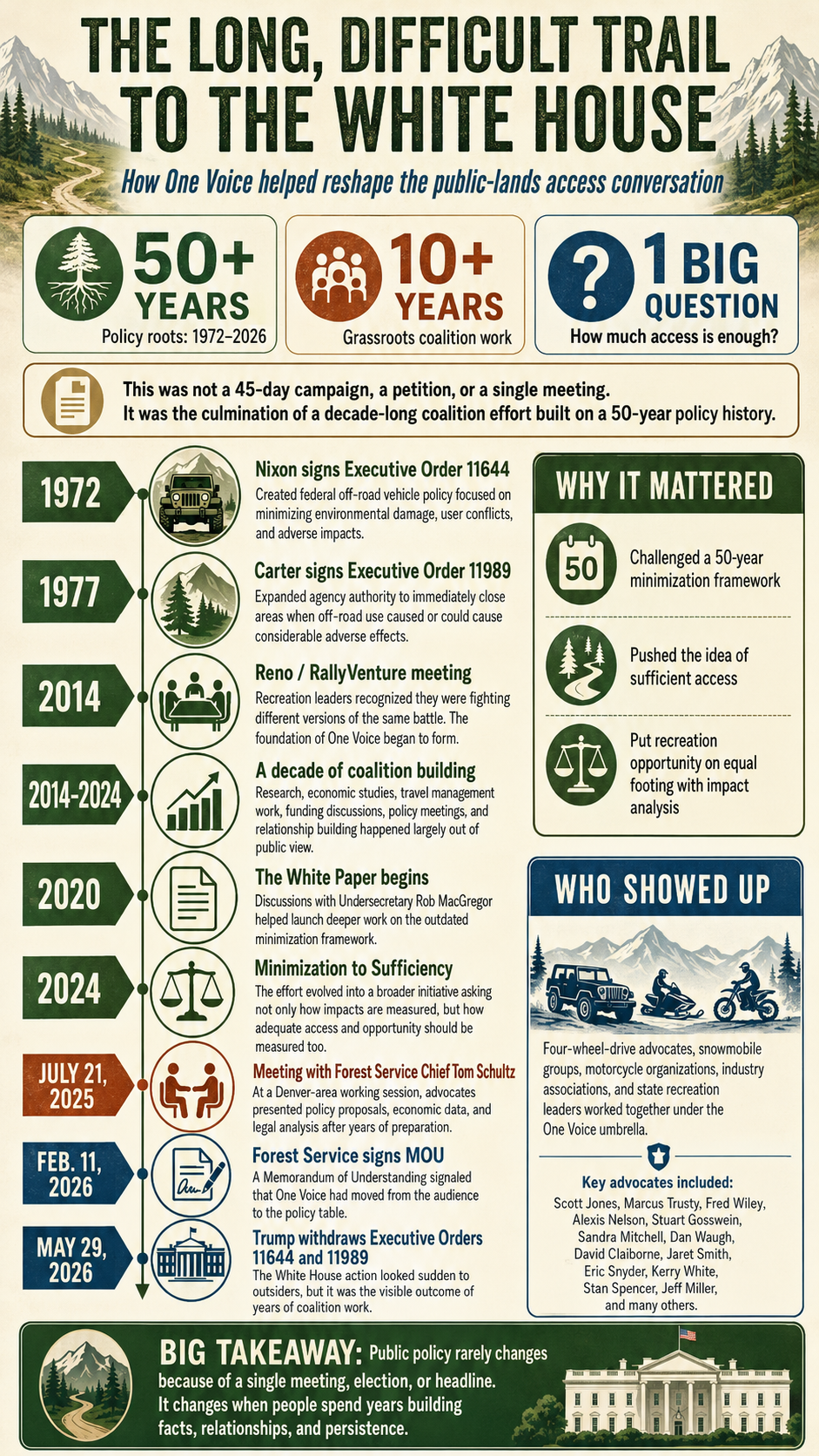
The turning point arrived in 2020 when discussions began with Rob MacGregor, then the Undersecretary of Agriculture responsible for overseeing the Forest Service. During those conversations, One Voice began developing what they referred to simply as "The White Paper." Their objective was not to save a specific trail or influence a particular planning decision. They were trying to understand why debates over recreational access seemed perpetually stuck in the same framework. The deeper they explored the issue, the more they found themselves returning to Nixon's Executive Order 11644 and Carter's Executive Order 11989. Those documents had become so deeply woven into public lands management that few people had stopped to ask whether they still reflected the realities of modern recreation.
Then politics intervened.
The 2020 election changed priorities in Washington, and momentum slowed. Many efforts disappear at that stage. This one did not. The coalition continued meeting. Research continued. Ideas evolved. The pause ultimately became an opportunity to refine the concept and transform what had begun as an internal discussion into something far more ambitious.
Following the 2024 election, the White Paper emerged in a new form. The effort became known as the Minimization-to-Sufficiency initiative. The title lacked the elegance of a campaign slogan, but the underlying idea represented one of the most significant challenges to federal recreation policy in decades. The coalition argued that while agencies had spent fifty years becoming extraordinarily skilled at measuring impacts, they had never developed meaningful standards for measuring opportunity. Federal law repeatedly instructed agencies to provide roads and trails adequate to meet public needs, yet concepts such as sufficient access, sufficient roads, and sufficient recreational opportunity remained largely undefined. The coalition was no longer arguing about closures. It was questioning the philosophy that guided the entire conversation.
The effort reached a pivotal moment on July 21, 2025, when a group of recreation advocates gathered at a hotel near Denver International Airport for an all-day meeting with Forest Service Chief Tom Schultz. Around the table sat many of the individuals who had spent years advancing the ideas now contained within the Minimization to Sufficiency initiative. Scott Jones, Fred Wiley, Marcus Trusty, Sandra Mitchell, Dan Waugh, David Claiborne, Jaret Smith, Eric Snyder, Kerry White, Stan Spencer, and others arrived carrying binders, policy proposals, economic data, legal analysis, and a decade's worth of accumulated experience navigating the complexities of federal land management.
What followed was not a ceremonial presentation. It was a working session that stretched from early morning until afternoon. Schultz spoke candidly about the Forest Service confronting significant staffing losses, growing maintenance backlogs, and increasing recreational demand. The discussion ranged from Shared Stewardship Agreements and travel management reform to recreation funding, road density standards, National Scenic Trail management, roadless area policy, and the future of recreation planning. Participants discussed the need for better access inventories, more effective partnerships, greater state involvement, and management systems capable of keeping pace with modern recreational realities. Throughout the conversation, one theme repeatedly surfaced. If recreation had become one of the largest uses of National Forest lands, why wasn't access being measured with the same seriousness as impacts?
The discussion eventually returned to the very issue that had sparked the coalition's work years earlier. Nixon's Executive Order 11644 was discussed directly. Jones argued that the order had become obsolete in light of modern statutes, policies, and management realities. Schultz acknowledged the concern and suggested that a future Secretarial Memorandum could begin to address concepts such as sufficiency and broader reforms advanced by the coalition. The conversation was no longer hypothetical. It had become a serious policy discussion taking place at the highest levels of the Forest Service.
Perhaps most significantly, the meeting laid the groundwork for a formal Memorandum of Understanding between One Voice and the Forest Service, signed by the Forest Service on February 11, 2026. For a coalition that had begun around a conference table in Reno a decade earlier, the MOU represented far more than another document. It was recognition that the recreation community had moved from the audience to the table itself. Executive summaries followed. Additional papers addressing the 2012 Planning Rule and the Roadless Rule followed. Discussions expanded to include Shared Stewardship models, Secretarial Memoranda, travel management reform, and broader questions surrounding public access. The ideas were no longer confined to recreation organizations. They had entered the policy arena.
Which brings us back to May 2026.
When President Trump withdrew Executive Orders 11644 and 11989, the decision appeared sudden to those encountering it for the first time. For the people who had spent more than a decade working on the issue, it looked very different. Marcus Trusty, Chairman of One Voice, described the action as "a huge step forward in providing adequate public access in all forms to public lands and implementing our minimization to sufficiency initiative." Scott Jones, Vice Chairman of One Voice, viewed it through an even longer lens, noting that "almost a decade of detailed work from One Voice and our members on this issue has started to provide benefits." Reflecting on the age of the Nixon-era framework, Jones observed that when those original orders were signed, "cutting-edge home technology was a toaster."
Whether one agrees with the policy outcome or not, the story behind it is difficult to ignore. The Executive Order was not the beginning of the story. It was the culmination of a long chain of events stretching from a pair of presidential signatures in the 1970s to a conference room in Reno in 2014, through years of coalition-building, research, and persistence, and ultimately back to the White House. It serves as a reminder that public policy rarely changes because of a single meeting, election, or politician. More often, it changes because a determined group of people spends years developing ideas, building relationships, and refusing to let a question die.
In this case, the question was remarkably simple.
What if the public lands system spent fifty years becoming extraordinarily good at measuring what could be lost, while never fully measuring what should be preserved? Sadly, it took more than a decade of dedicated work from a handful of people for Washington to seriously consider the answer.
Closing thoughts.
History has a curious habit of attaching itself to presidential signatures while quietly forgetting the people who spent years laying the groundwork that made those signatures possible.
The withdrawal of Executive Orders 11644 and 11989 will forever be associated with President Donald Trump, just as those orders will forever be associated with Presidents Richard Nixon and Jimmy Carter. Yet the story behind this moment belongs to a much larger cast of characters. It belongs to the recreation advocates who spent more than a decade asking difficult questions, challenging long-held assumptions, building relationships, conducting research, writing policy proposals, attending meetings, and refusing to accept that the future of public access had already been decided.
Fred Wiley, Scott Jones, Marcus Trusty, Alexis Nelson, Stuart Gosswein, Sandra Mitchell, Dan Waugh, David Claiborne, Jaret Smith, Eric Snyder, Kerry White, Stan Spencer, Jeff Miller, and many others whose names may never appear in headlines but whose fingerprints can be found throughout this effort.
Their work was strengthened by a coalition that crossed organizational, geographic, and recreational boundaries. Snowmobilers worked alongside four-wheel-drive advocates. Motorcycle organizations sat down with industry leaders. State associations collaborated with national organizations. Competitors became partners. Individual interests gave way to shared objectives. What emerged was not another advocacy organization, but a movement built around a simple idea: public lands belong to the public, and access deserves a seat at the table alongside every other management objective.
The organizations involved in that effort include the Off-Road Business Association, Colorado Off-Highway Vehicle Coalition, Idaho Recreation Council, United Snowmobile Alliance, International Snowmobile Manufacturers Association, Specialty Equipment Market Association, Citizens for Balanced Use, United Four Wheel Drive Associations, American Motorcyclist Association, Colorado Off-Road Enterprise, Nevada Off Road Association, Colorado Snowmobile Association, Montana Sled Patriots, Southern Four Wheel Drive Association, and numerous other state, regional, and national organizations whose members contributed time, expertise, funding, and countless volunteer hours to the cause.
Whether one agrees with the outcome or not, the larger lesson should not be missed.
Public lands policy is not written solely in Washington, D.C. It is shaped by citizens who choose to engage rather than observe, participate rather than complain, and build rather than simply react. The story of One Voice demonstrates that a small group of committed individuals, armed with little more than persistence, facts, relationships, and a willingness to work together, can still influence the direction of public policy in America.
The next chapter has not yet been written.
The questions surrounding access, stewardship, conservation, and recreation will continue long after today's headlines fade from memory. The future will belong to those willing to show up, get involved, and do the work. If the last decade has proven anything, it is that meaningful change rarely begins in the halls of government.
More often, it begins around a conference table, with a handful of people willing to ask a question nobody else is asking and stubborn enough to keep pursuing the answer.
Reprint Permission: This article may be shared or republished in full, provided it is reproduced exactly as originally published and includes the author’s byline. No edits, excerpts, rewrites, summaries, translations, artificial intelligence-generated versions, derivative works, or manipulated versions are permitted without prior written permission from the author.
By Jeff Knoll Find me on LinkedIn @ https://www.linkedin.com/in/jeff-knoll-b5632437/
Originally published at: https://www.onevoicerec.org/news
© 2026 Jeff Knoll. All rights reserved except as expressly permitted above.