The Executive Order Did Not Open the Gates. It Opened the Conversation.
By Jeff Knoll
Public land debates often ignite quickly. A headline drops, a post spreads, an advocacy group amplifies the most dramatic version, and soon the public hears Jeeps, ATVs, dirt bikes, and side-by-sides have invaded Wilderness areas, National Parks, and every fragile ecosystem nationwide.
That is not what happened.
The President’s May 29 Executive Order rescinds Executive Orders 11644 (1972) and 11989 (1977), directing agencies to review and revise the regulations issued under them. The White House frames this as a move to remove unnecessary restrictions and responsibly expand access. This is a real policy shift; denying that misrepresents the administration's direction.
Equally important: the Executive Order does not automatically open every road, trail, park, recommended Wilderness, or sensitive habitat to off-road use.
This is not political spin; it is a matter of civics.
Designated Wilderness is governed by the Wilderness Act, a law passed by Congress. It generally prohibits motor vehicles, equipment, motorboats, aircraft, and mechanical transport, with rare exceptions. A President cannot erase an act of Congress by executive order.
National Parks operate under the National Park Service's laws and regulations. 36 CFR 4.10 generally prohibits motor vehicles except on park roads, parking areas, or designated off-road routes. Creating exceptions requires regulatory steps—not headlines or rumors.
National Forests follow travel-management rules. Motor vehicle use is limited to designated roads, trails, and areas noted on Motor Vehicle Use Maps. The travel-management rule requires these designations and bans unauthorized use.
This crucial point is being overlooked.
The Executive Order shifts policy. It does not change travel maps, remove closure signs, repeal the Wilderness Act, or revise all forest plans, park regulations, refuge rules, or BLM travel designations overnight. It does not permit off-road driving through closed or sensitive areas.
If a road or trail was closed before the order, users should assume it remains closed unless the managing agency officially says otherwise.
This is both the responsible and legally correct answer.
Complications arise for lands not congressionally designated as Wilderness but managed as recommended Wilderness, protected roadless areas, or with reduced motorized access via agency plans. Based on current reporting and an Agriculture Department memo, the Department is exploring whether some roads, trails, airstrips, and waterways should be reconsidered for recreation access, even where past recommendations changed management.
This is significant in states like Idaho and Montana, where much land is administratively restricted but not designated as Wilderness by Congress. The policy question remains: should agency recommendations replace congressional action? Should traditional access routes for families, hunters, anglers, communities, outfitters, and responsible recreation be reviewed? Should access be managed by transparent, site-specific decisions instead of inertia?
Those are fair questions. This is not the same as saying, “The President opened Wilderness to ATVs.” That claim is false.
That false claim is dangerous; it fuels emotional reactions. When people believe national parks and Wilderness areas have opened to unregulated off-road use, anger replaces understanding. Good-faith users become villains, agencies face panic, media chase drama, advocacy groups raise funds through fear, and public-land management gets lost in the smoke.
One Voice believes the public deserves better.
Motorized recreation is a valid public land use, as are hiking, horseback riding, mountain biking, hunting, angling, paddling, wildlife viewing, camping, skiing, and quiet recreation. None benefits from misinformation. Responsible use relies on clear rules, accurate maps, an honest process, sound data, local knowledge, and stewardship on the ground, not just in statements.
The Executive Order is a policy reset, directing agencies to review access management under previous orders. It may prompt agencies to review closures, reconsider routes, restore access, and address management decisions that treat motorized use as a problem rather than a public use. It may also start rulemaking, public comments, environmental reviews, and spark debates over access decisions.
That is the work ahead. But it is not a free-for-all.
Anyone who values responsible access should say so plainly. Off-road users must stay on designated routes, follow current maps and signs, respect seasonal closures, avoid damaging resources, and not treat national announcements as local permission. Reckless acts do not prove points—they arm opponents to close more places.
Journalists and advocacy groups should stop presenting every access issue as an ecological crisis. Words matter. "Could lead to agency review" does not mean "opens national parks to vehicles." "Reconsidering management" is not "repealing the Wilderness Act." "Expanding responsible access" is not "unregulated destruction."
The public can handle the truth. In fact, the public deserves it.
The truth: the Executive Order matters, but it does not open all areas. Existing laws, agency rules, travel maps, and closures remain until lawfully changed. Designated Wilderness is protected by statute, national parks follow their regulations, and national forests and BLM lands remain subject to planning and travel management.
The real issue is whether Americans will have a serious conversation about access, stewardship, multiple use, and the future of public lands—without panic fundraising.
One Voice is publishing this FAQ to help ground that conversation in facts.
Public lands belong to all of us. Good management needs more than slogans or fear. It needs citizens who go beyond headlines, respect the law, engage in the process, and take responsibility for their impact on the land. The gates did not fly open. The conversation did.
Now is the time to ensure the conversation is honest.
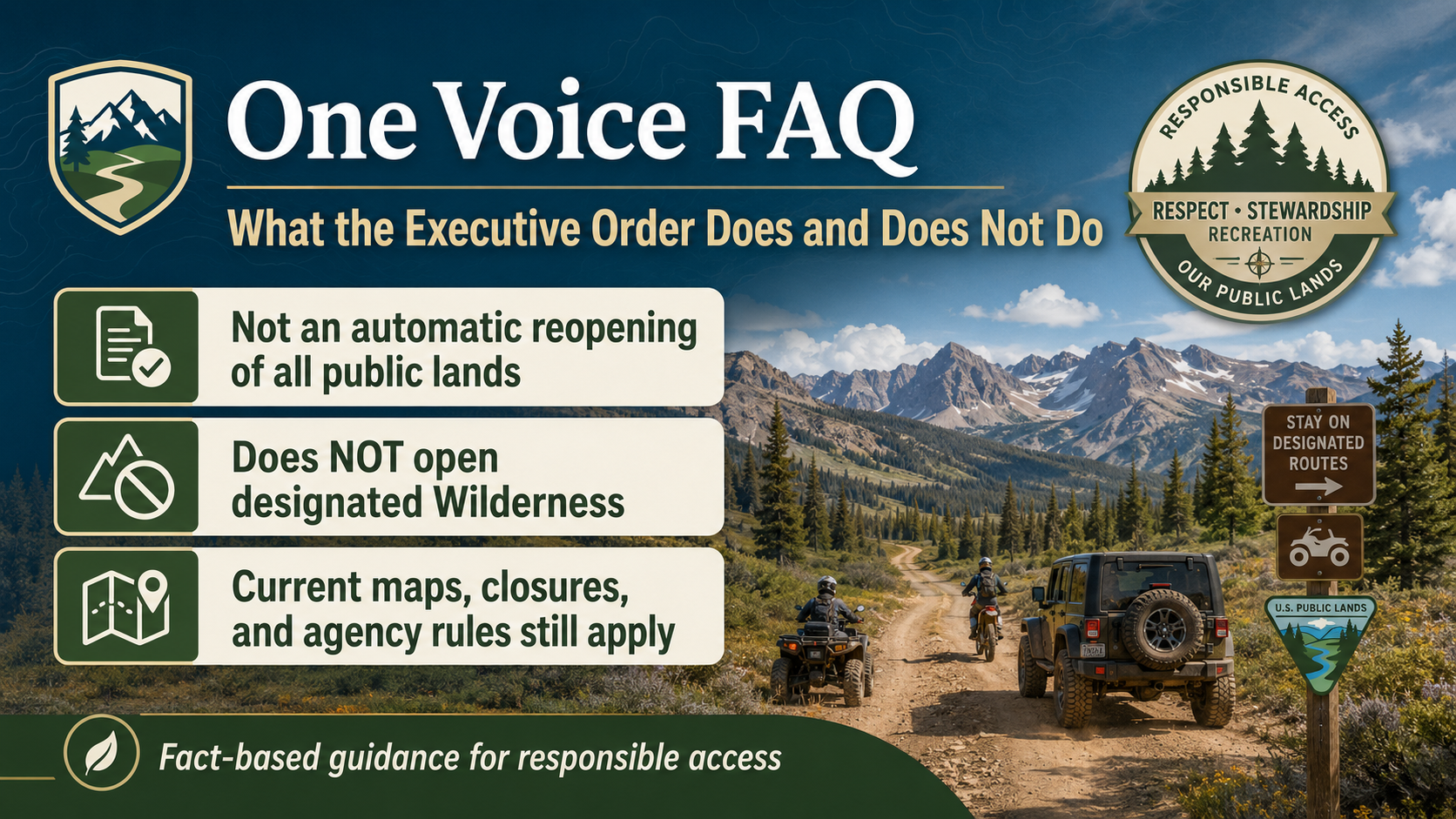
One Voice Fact Sheet
Frequently Asked Questions About the May 29 Executive Order on Off-Road Vehicle Access to Federal Public Lands
Purpose of this FAQ:
This document is intended to explain, in plain English, what the President’s recent Executive Order does, what it does not do, and how off-road vehicle access on federally managed public lands is governed. It is designed for public use, publication, reposting, and distribution by recreation organizations, clubs, media outlets, elected officials, agency partners, and the general public.
1. What did the Executive Order do?
The Executive Order rescinded two prior executive orders: Executive Order 11644, signed in 1972, and Executive Order 11989, signed in 1977. Those earlier orders directed federal land-management agencies to regulate off-road vehicle use on public lands and to use criteria intended to minimize resource damage, wildlife impacts, and user conflicts. The new Executive Order directs federal agencies to begin revising or rescinding regulations that implemented those earlier executive orders.
In plain English, the Executive Order changes federal policy direction. It does not automatically open every closed road, trail, wilderness area, national park, refuge, or sensitive ecosystem to motorized use.
2. Does the Executive Order immediately open all federal public lands to off-road vehicles?
No.
That is one of the most important facts to understand. The Executive Order does not function like a master key that unlocks every road, trail, or closed area. Federal land access is still governed by statutes, agency regulations, land-use plans, travel-management plans, maps, local orders, seasonal closures, resource protections, and site-specific decisions.
The White House described the order as rescinding prior executive orders and directing agencies toward new rulemaking. That means agencies must still go through legal and administrative processes before changing many existing access rules.
3. Does the Executive Order allow off-road vehicles in designated Wilderness areas?
No.
Designated Wilderness is governed by the Wilderness Act, which was passed by Congress. The Wilderness Act generally prohibits motor vehicles, motorized equipment, motorboats, landing of aircraft, and mechanical transport inside designated Wilderness areas, except for narrow statutory exceptions. A presidential executive order cannot simply erase a congressional statute.
In plain English, designated Wilderness remains closed to recreational off-road vehicle use unless Congress changes the law or a specific statutory exception applies.
4. Does the Executive Order open National Parks to off-road vehicles?
No, not by itself.
National Park Service rules still generally prohibit motor vehicle use except on park roads, in parking areas, and on routes or areas specifically designated for off-road motor vehicle use. NPS regulations at 36 CFR 4.10 remain important, and off-road vehicle designations in parks require specific legal and regulatory steps.
Some media reports and social media posts have implied that the Executive Order will allow off-road vehicles in “most national parks.” That is an overstatement. National parks are not automatically opened to off-road travel because of this Executive Order.
5. Does the Executive Order open National Forests to cross-country travel?
No.
National forests are still managed through the Forest Service travel-management system. Under current travel-management regulations, motor vehicle use is tied to designated roads, trails, and areas, usually shown on Motor Vehicle Use Maps. The Forest Service travel-management framework identifies where motorized use is allowed, what types of vehicles are allowed, and when seasonal or vehicle-class restrictions apply.
The Executive Order may lead to future changes in how agencies review access, restore routes, revise designations, or reconsider prior closures, but it does not automatically authorize cross-country travel across national forests.
6. Does the Executive Order open Bureau of Land Management lands to unrestricted off-road travel?
No.
BLM lands are still governed by land-use plans and off-road vehicle designations. BLM regulations classify lands as open, limited, or closed to off-road vehicle use. Those designations still matter unless and until they are changed through lawful agency action.
Some BLM areas are already managed for motorized recreation. Others are limited to designated routes. Others are closed to motorized use for resource, safety, cultural, wildlife, or administrative reasons. The Executive Order does not erase those categories overnight.
7. What about recommended Wilderness areas?
Recommended Wilderness areas are not the same as congressionally designated Wilderness. Only Congress can officially designate Wilderness.
However, recommended Wilderness areas are often managed to preserve the wilderness characteristics that made them eligible for recommendation. Based on current reporting, the Department is exploring whether some roads, trails, airstrips, and waterways should be reconsidered for recreation access, even where past recommendations changed management.
That is a major policy issue, especially in states like Idaho and Montana, where large acreages may be involved. But it is still not the same as saying designated Wilderness is open to off-road vehicles.
8. What is the difference between “off-road vehicle use” and “driving off trail”?
This distinction matters.
In federal land-management language, “off-road vehicle” or “off-highway vehicle” often refers to the type of vehicle or the regulatory category, not permission to drive wherever one wants. A Jeep, motorcycle, ATV, UTV, snowmobile, or other motorized vehicle may be called an off-road vehicle even when it is legally restricted to designated roads, trails, or areas.
Responsible motorized access usually means traveling on designated routes, not driving cross-country through meadows, wetlands, streambeds, alpine tundra, cultural sites, wildlife habitat, or closed areas.
9. Does this Executive Order eliminate environmental review?
No.
The Executive Order does not repeal the National Environmental Policy Act, the Wilderness Act, the National Historic Preservation Act, the Endangered Species Act, the National Park Service Organic Act, the Federal Land Policy and Management Act, forest plans, resource management plans, or local travel-management decisions.
Agency decisions that change access may still require environmental review, public notice, public comment, consultation, or other legal steps, depending on the action and the land-management unit involved.
10. Does this Executive Order mean public lands will become “unregulated”?
No.
That claim is emotionally charged and inaccurate.
Federal public lands remain regulated by a large framework of laws, regulations, plans, maps, permits, closures, and enforcement authorities. The Executive Order changes direction at the presidential policy level. It does not abolish land-management agencies. It does not eliminate travel maps. It does not repeal congressional statutes. It does not suspend law enforcement. It does not authorize reckless use.
The claim that this creates “unregulated motorized use” is best understood as advocacy rhetoric rather than a complete legal description.
11. Why are some headlines saying this opens National Parks, Wilderness, or sensitive ecosystems?
Because emotionally charged public-land debates often collapse complex policy into simple alarm language.
Some articles and social media posts have framed the Executive Order as if it instantly opens national parks, Wilderness areas, and sensitive ecosystems to off-road vehicles. That is misleading. A more accurate statement would be:
The Executive Order rescinds two older executive orders and directs agencies to reconsider regulations and policies related to off-road vehicle access. Future agency actions could affect access decisions on some federal lands, but existing statutes, regulations, land-use plans, and travel-management rules remain controlling unless lawfully changed.
12. Is it fair to say the Executive Order is meaningless?
No.
That would also be inaccurate.
The Executive Order is meaningful because it changes federal policy direction and instructs agencies to revisit regulations tied to prior executive orders. It may lead to more access reviews, more route reconsiderations, more challenges to blanket closures, and new agency rules or guidance. It also sends a clear message that the administration wants federal land management to give more weight to recreation access and multiple use.
The honest answer is this: the Executive Order matters, but it is not a self-executing access permission.
13. Can agencies reopen previously closed roads and trails?
Yes, in some cases.
Agencies may be able to reconsider closed roads, trails, or areas through lawful administrative processes. That may include route-by-route reviews, travel-plan amendments, consistency reviews of forest- and resource-management plans, environmental analyses, public involvement, and coordination with state, county, tribal, and local stakeholders.
But the process matters. A road or trail that is closed today generally remains closed until the managing agency lawfully changes that status.
14. Can agencies still close routes to protect resources?
Yes.
Federal agencies still have authority to manage use, protect resources, address safety concerns, protect wildlife habitat, reduce conflicts, prevent erosion, protect cultural resources, and respond to emergency conditions such as fire, flood, washouts, or resource damage.
The debate is not whether agencies can manage motorized use. They can. The debate is how closures are justified, how access is evaluated, whether decisions are balanced, whether local communities are heard, and whether motorized recreation is treated as a legitimate public-land use.
15. What should off-road users do right now?
Off-road users should continue to follow current maps, signs, travel-management rules, seasonal restrictions, and local orders.
The practical rule is simple: if a road, trail, or area was closed before the Executive Order, assume it is still closed unless the managing agency officially says otherwise.
Responsible recreation is essential. Irresponsible use gives opponents easy ammunition and damages the credibility of every organization working to restore access.
16. What should non-motorized users understand?
Non-motorized users should understand that this Executive Order does not automatically eliminate quiet recreation, close hiking trails, remove wildlife protections, or open Wilderness areas to motorized recreation.
Motorized recreation and quiet recreation can coexist when management is based on facts, designated systems, local conditions, user education, enforcement, and honest planning. Conflict grows when one user group is treated as illegitimate or when misinformation is used to frighten the public.
17. What should journalists and editors avoid saying?
Journalists should avoid statements that imply the Executive Order immediately opens:
designated Wilderness areas,
most National Parks,
all National Forests,
wildlife refuges,
roadless areas,
sensitive ecosystems,
closed trails,
or all public lands to unrestricted off-road travel.
Those claims are not accurate without major qualifications.
A responsible headline would say something like:
“Executive Order Directs Federal Agencies to Reconsider Off-Road Vehicle Access Rules on Public Lands.”
A misleading headline would say:
“Trump Opens Wilderness and National Parks to Off-Road Vehicles.”
The second version may get clicks, but it does not accurately explain the law.
18. What is the best one-sentence explanation?
The Executive Order rescinds two older executive orders and directs federal agencies to revisit off-road vehicle access rules, but it does not automatically open Wilderness areas, national parks, closed trails, or sensitive habitats to motorized use.
19. What is the One Voice position?
One Voice supports fact-based, responsible access to public lands. That means motorized recreation must be treated as a legitimate use of public lands, not as a political villain. It also means access decisions should be made through transparent, lawful, site-specific processes that consider recreation, conservation, safety, local economies, stewardship, and the needs of all users.
Public lands belong to the public. They should not be managed through fear, misinformation, or emotional stampedes. They should be managed through facts, law, good data, local knowledge, and responsible stewardship.
20. What misinformation should be corrected?
The following claims should be corrected when they appear in articles, social media posts, fundraising emails, or public comments:
Claim: “The Executive Order opens Wilderness to off-road vehicles.”
Correction: Designated Wilderness remains governed by the Wilderness Act, which generally prohibits recreational motorized use.
Claim: “The Executive Order opens most national parks to off-road vehicles.”
Correction: National Park Service regulations still generally prohibit motor vehicle use except on park roads, parking areas, and specifically designated routes or areas.
Claim: “The Executive Order creates unregulated off-road use.”
Correction: Federal lands remain subject to statutes, regulations, travel-management plans, land-use plans, maps, local orders, and enforcement.
Claim: “Every closed road or trail is now open.”
Correction: Closed roads and trails remain closed unless and until the managing agency lawfully changes their status.
Claim: “Nothing changed.”
Correction: The policy direction changed. Agencies have been directed to revisit regulations and policies tied to the rescinded executive orders. That matters, but it is not the same as immediate route-level access.
Closing Statement
The public deserves the truth, not panic.
The President’s Executive Order is an important policy shift for motorized recreation and public-land access. It may create opportunities to review closures, restore reasonable access, and correct decades of imbalance in federal land management. But it does not give anyone permission to ignore maps, signs, closures, or the law.
One Voice encourages all recreation users, motorized and non-motorized alike, to read beyond the headline, check the source documents, respect current rules, and participate in the public process. Responsible access is built by people who show up, tell the truth, and do the work.
Reprint Permission: This article may be shared or republished in full, provided it is reproduced exactly as originally published and includes the author’s byline. No edits, excerpts, rewrites, summaries, translations, artificial intelligence-generated versions, derivative works, or manipulated versions are permitted without prior written permission from the author.
By Jeff Knoll Find me on LinkedIn @ https://www.linkedin.com/in/jeff-knoll-b5632437/
Originally published at: Onevoicerec.org/news
© 2026 Jeff Knoll. All rights reserved except as expressly permitted above.