Granite, Water, and Shovels: Lessons from the Rubicon Trail
Part 3 in a series on conservation in the American West
By Jeff Knoll
There is a certain kind of trail in the American West that refuses to behave like a line on a map. It bends around granite outcroppings and vanishes into timber, crossing cold creeks without ceremony and climbing into country where the mountains seem only reluctantly willing to tolerate human ambition. These are not roads in the modern sense. Roads belong to surveyors, engineers, and transportation departments. Trails like the Rubicon belong to weather, gravity, memory, and stubbornness. They are negotiated places. Temporary treaties scratched into landscapes by generations of people who return season after season, believing, against all evidence to the contrary, that the mountains may permit one more passage.
The Rubicon Trail has always carried a little of that spirit. Long before the modern arguments over recreation, access, and environmental management arrived with binders and acronyms, people came through this country because they wanted to see what was on the other side.
Prospectors crossed it. Early travelers crossed it. Jeepers crossed it. Entire communities eventually grew around the idea that some places are worth experiencing precisely because they demand effort. The Rubicon was never simply a route. It was a proving ground, a shared story, and eventually a small economy built around a rough ribbon of rock stretching through the Sierra.
For decades, people assumed that keeping places like this alive was someone else's responsibility. Somewhere out there, beyond the campfire and beyond the dust-covered windshield, there existed agencies with offices and budgets and experts whose purpose was to manage the landscape while the rest of us simply passed through it. That arrangement worked reasonably well for a long time, at least so long as nobody looked too closely at the arithmetic. Public land management in America often operates on a quiet faith that tomorrow's needs can somehow be carried by yesterday's staffing levels and budgets. Trails are repaired later. Problems are studied later. Deferred maintenance becomes tomorrow's problem right up until tomorrow arrives.
Around the year 2000, tomorrow arrived on the Rubicon.
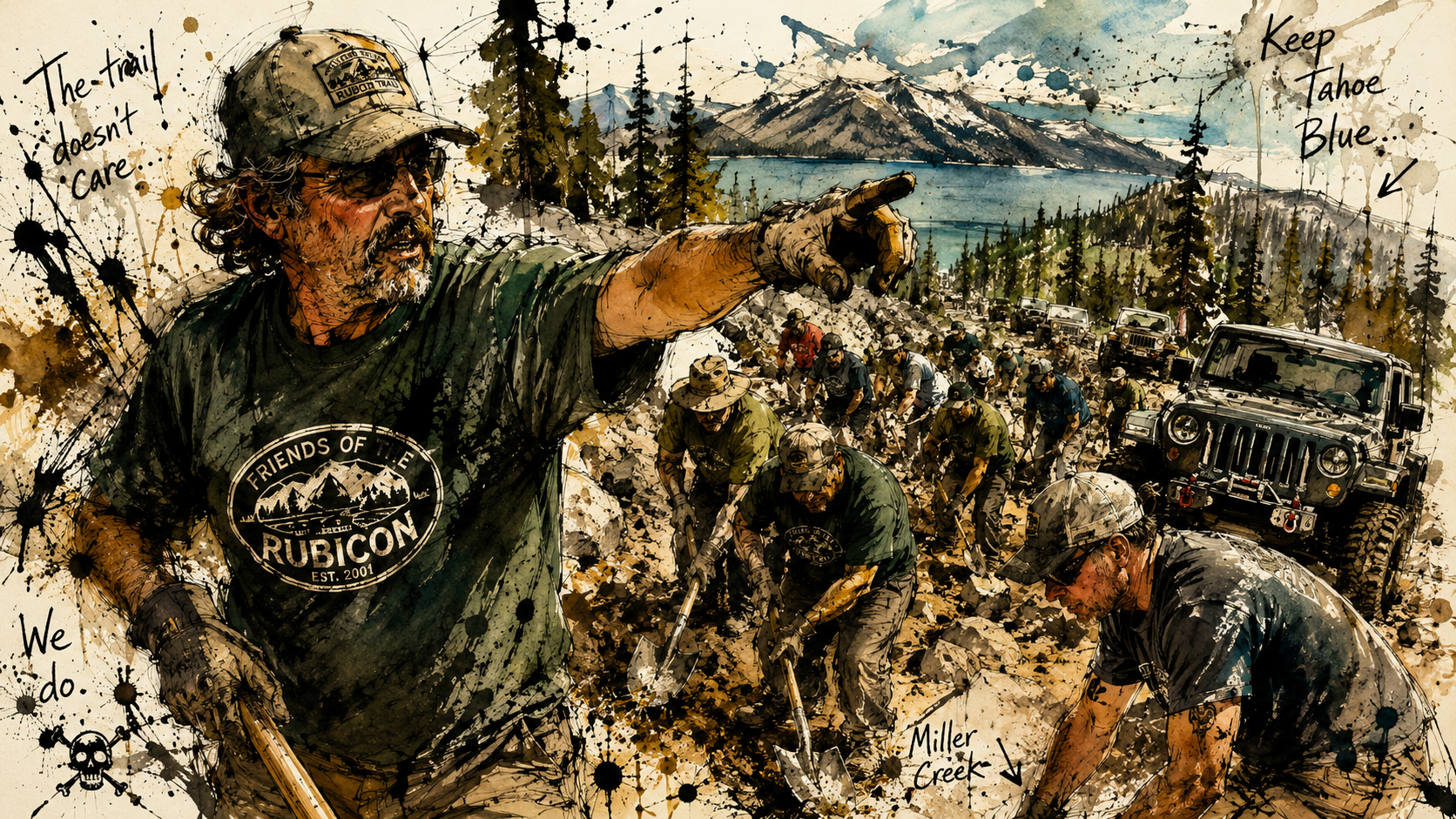
The concerns gathering around the trail were not imaginary, and this is where the story becomes more complicated than the familiar caricature in which one side loves the land, and the other merely uses it. Sediment and runoff entering Miller Creek on the Placer County side of the trail had become part of a larger concern surrounding water quality in Lake Tahoe. To anyone unfamiliar with the Sierra, this might sound like a technical issue buried in agency language, but in Tahoe country, the idea borders on heresy. Entire campaigns had formed around a simple message: Keep Tahoe Blue. The lake itself had become a kind of civic religion, and officials feared sediment moving through the watershed could eventually contribute to larger ecological consequences downstream.
The threat did not arrive dramatically. Nobody rolled in and locked a gate overnight. Like most things in public lands management, it arrived through letters and findings and meetings and concerns that slowly accumulated until closure no longer sounded radical. It sounded reasonable. At one point, a cease-and-desist order hung over the county, carrying penalties severe enough to make everyone understand that this had moved beyond a routine disagreement. People genuinely believed the trail could be lost.
For a while, it appeared they might be right. Then something happened that did not fit the familiar script. Instead of organizing around outrage, users organized around work.
In August of 2001, nearly one hundred and fifty volunteers traveled from around the country carrying shovels, tools, and enough determination to make a bureaucrat uncomfortable. They came from clubs and organizations with their own histories and rivalries and ideas about who deserved credit, but for a few days, that old my club, my trail nonsense got shoved aside in favor of something simpler. Under the banner of Friends of the Rubicon, they showed up wearing the same shirts and carrying the same mission. Nobody arrived to defend the territory. Nobody arrived to issue press releases. They arrived at work.
Crews spread out across the Miller Creek side of the trail, repairing sediment problems and installing water bars designed to keep runoff from doing what water has always done when left unattended: take the easiest path downhill and bring pieces of the mountain with it. To someone passing by, the work probably looked ordinary enough. Dust-covered people carrying rocks, digging trenches, and sweating under a Sierra sun. Yet landscapes often turn on surprisingly small things. Entire watersheds can change because somebody moved a drainage a few feet uphill or placed stone where runoff once gathered speed.
By Saturday evening, after a day spent hauling rock and reshaping the trail, the volunteers gathered around camp where the California Four Wheel Drive Association fed the crews steaks. It is a small detail, but the outdoors is often understood through small details. The smell of smoke settles into clothes. Folding chairs arranged in rough circles. Dust hanging in the evening air. Somebody is laughing near a line of parked Jeeps while shovels lean against tires still warm from the trail.
That scene paved the way for what was taking shape on the Rubicon. It was not a protest movement. It was not a lobbying campaign. It looked more like a barn raising. People had gathered not because they agreed on everything, but because they agreed on one thing. The trail itself mattered more than whatever separated them.
As the work continued, the effort grew beyond volunteer weekends alone. Donations started arriving. Projects became more complex. The realities of sustaining long-term stewardship demanded a structure capable of accepting funds and coordinating future efforts, which eventually led to the formation of the Rubicon Trail Foundation. Yet even as organizations evolved, the center of gravity never truly changed. The work had already begun. The dirt had already been turned. The idea had already proven itself.
Around the same time, another lesson slowly emerged from the granite. No single organization was going to save the Rubicon. Not volunteers alone. Not agencies. Not counties. Not event promoters. Not private landowners. The answer turned out to be cooperation itself.
Groups like Jeepers Jamboree brought economic activity and logistical support. Counties brought resources. Federal land managers brought planning authority. Volunteers brought labor.
Eventually, all of those interests found themselves gathered beneath the umbrella of the Rubicon Oversight Committee, or ROC, which sounds exactly like the kind of acronym designed to empty a room after lunch. Yet beneath the bureaucratic title sat one of the more remarkable conservation ideas to emerge from modern recreation culture.
ROC represented shared ownership. Not legal ownership, but the understanding that everyone around the table had skin in the game.
For generations, Americans have framed public lands as a contest between opposing camps. Recreation versus conservation. Users versus agencies. Access versus protection. The Rubicon suggested another possibility. It suggested that people who love landscapes enough to use them may eventually learn to love them enough to maintain them.
The mountains, as mountains often do, eventually introduced another challenge. Along sections of narrow sidehill terrain above Miller Creek, gravity resumed its patient work. Drainage patterns shifted. Soil loosened. The trail itself began expressing opinions about where it intended to remain and where it preferred to return to the mountain below.
Faced with terrain that could not be stabilized forever, land managers working through the United States Forest Service and Tahoe National Forest eventually pursued reroutes rather than closure. That decision carries within it a quiet form of optimism. It assumes a trail is worth keeping. It assumes people will return. Most importantly, it assumes conservation and access are not opposing ideas standing across a courtroom aisle from one another, but two participants in an ongoing conversation between landscape and people.
The Rubicon did not survive because somebody won an argument. It survived because people decided to pick up shovels before somebody else picked up the gate.
Perhaps that is the larger lesson waiting out there in the dust and granite. Across the country, public land agencies are facing the same arithmetic of growing use, aging infrastructure, deferred maintenance, and limited budgets. Hidden inside that equation may be a realization of the Rubicon discovered twenty-five years ago beneath a Sierra sky and beside a line of parked Jeeps.
The people already gathering around campfires, trailheads, and volunteer weekends may represent one of the largest conservation workforces America has never fully recognized. The question now is not whether communities like this can exist. The question is whether the rest of us have noticed what they have already become.
Reprint Permission: This article may be shared or republished in full, provided it is reproduced exactly as originally published and includes the author’s byline. No edits, excerpts, rewrites, summaries, translations, artificial intelligence-generated versions, derivative works, or manipulated versions are permitted without prior written permission from the author.
By Jeff Knoll Find me on LinkedIn @ https://www.linkedin.com/in/jeff-knoll-b5632437/
Originally published at: https://www.onevoicerec.org/news
© 2026 Jeff Knoll. All rights reserved except as expressly permitted above.