Command Over Confusion
Why One Voice Needs an Operating System Before the Next Closure Burns Through the Map
By Jeff Knoll
A wildfire has no manners. It does not stop at the Forest Service boundary and wait for someone to find the right line officer. It does not ask the Bureau of Land Management whether the travel plan is current. It does not pause at a county road while the commissioners review the agenda. It does not tiptoe around tribal interests, state wildlife concerns, city limits, private inholdings, utility corridors, water systems, grazing allotments, trailheads, campgrounds, or somebody’s old dream cabin with a rusted CJ-5 parked behind it like a shrine to better decisions and worse fuel mileage. Fire just moves.
It crawls through grass, climbs timber, jumps roads, eats fence lines, chokes towns, rattles ranchers, scares politicians, and very quickly separates the people with a plan from the people surviving on good intentions, old grudges, and laminated mission statements. In the West, fire is a savage auditor. It does not care who wrote the memorandum. It does not care who has seniority. It does not care who gets credit when the smoke clears. Fire finds the weak seam in the system and runs through it with orange teeth. That is why the Incident Command System exists.
Not because firefighters secretly love bureaucracy. They do not. Most firefighters would rather dig line through a granite quarry with a garden spoon than attend another meeting run by someone who says “circle back” with a straight face. ICS exists because chaos is expensive, confusion is dangerous, and courage without structure eventually becomes a memorial plaque. ICS was never valuable only because it worked on fires. It was valuable because it created a way for independent people, agencies, resources, and responsibilities to move together without requiring everyone to surrender their authority to one grand emperor in yellow Nomex. That idea is not new to our world.
Del Albright saw the bridge decades ago. In 1987, Delmer L. Albright wrote a paper for the USDA Forest Service proceedings titled “Adapting the Incident Command System to Meeting or Conference Management.” The title alone should make every land-use leader lean forward. Del was not writing about dragging hose through manzanita or ordering aircraft over a ridge. He was writing about taking the bones of ICS and applying them to organized human work outside the emergency scene. He argued that ICS was well suited to large meetings because the staff structure, duties, management process, and forms were already developed and could be adapted.
That is the buried treasure. Del was not worshiping the form. He was stealing the useful machinery. He identified the ingredients of a successful ICS-managed conference: staff, a game plan, planning meetings, visualization, logistics, active participants, a time schedule, social activities, checks and double checks, and professionalism. That list may sound painfully ordinary until you compare it to the average access fight, where the “game plan” often consists of a Facebook post, three urgent phone calls, one angry email chain, and a prayer that someone, somewhere, has the map.
Del also warned against waiting too long to bring key staff into the planning process. He recommended staffing up early, filling positions as the incident expands, and assigning people into clear roles such as Incident Commander, Operations, Logistics, Finance, Information, Planning, and Facilities. For our purposes, that may be the whole sermon. Do not wait until the closure is already burning through the map before asking who owns the shovel. Now look at a trail closure.
Not the cartoon version where a villain in a fleece vest wakes up one morning, strokes a white cat, and decides to close a road because he hates families, dogs, Jeeps, dirt bikes, camp coffee, and the smell of two-stroke oil.
A closure begins with a damaged meadow, a bad map, a cultural-resource concern, a lawsuit threat, a travel management revision, a county road dispute, user conflict, a permit problem, a poorly documented route, a viral video, a seasonal restriction, a wildlife concern, a new staff person with no institutional memory, or a planning process that has been moving quietly for years while most of us were busy checking tire pressure and arguing about beadlocks. Then one day the notice drops and the flames are suddenly everywhere.
The local club knows the ground but has no communications machine. The national group has legal experience but may not know which ranch gate opens or which county commissioner actually returns phone calls. Industry has economic weight but does not want to walk blindfolded into a knife fight without facts. The stewardship group has credibility but cannot be used as decorative shrubbery after the damage has already made the newspaper. The land manager is hearing from environmental groups, county officials, business owners, local users, elected offices, and some digital patriot named TrailCrusher76 who believes all caps are a form of constitutional law.
By the end of the first week, everyone is busy. Busy feels like progress when panic is in the room. But busy is often just confusion wearing work gloves. One Voice has an opportunity to change that.
Not by becoming king of the OHV world. Not by becoming the United Nations with mud tires. Not by building another coalition logo wall where good intentions go to molt in fluorescent lighting. One Voice can become the operating table where the motorized recreation community learns to respond to access threats with the discipline of a fire team instead of the emotional stability of a comments section.
That does not mean One Voice commands the movement. It means One Voice commands the confusion. There is a difference, and if we miss it, the whole thing goes bad.
When a fire crosses Forest Service land, Bureau of Land Management land, tribal land, state land, county land, city property, utility corridors, and private ground, the agencies do not all surrender their sovereignty. The tribe remains the tribe. The county remains the county. The Forest Service remains the Forest Service, for better or worse, and usually with a binder thick enough to stun livestock.
Inside Unified Command, the parties agree to operate from a shared picture of reality. The National Park Service describes Unified Command as an ICS application used when more than one agency has jurisdiction, allowing agencies to work together to establish common objectives, common strategies, and a single Incident Action Plan. That is the model.
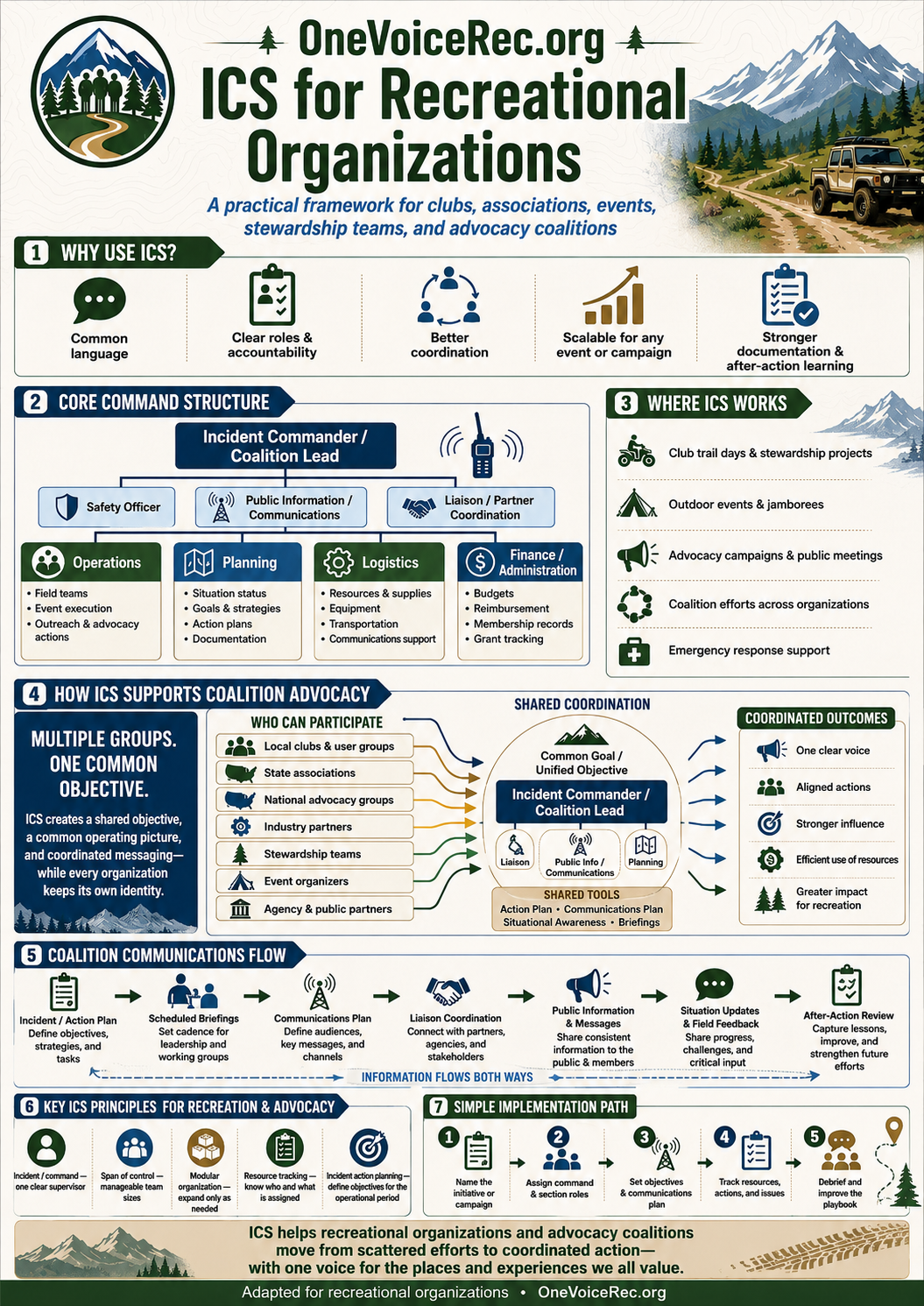
A trail closure crossing multiple interests needs the same discipline. The land manager keeps authority. The local club keeps ground truth. The legal advocate keeps the legal lane. The stewardship partner keeps credibility. Industry keeps economic weight. The county keeps its local government role. The event promoter keeps operational knowledge. The sponsor keeps its investment interest. One Voice does not replace any of them.
One Voice gives them a fireline to work from. The first move is simple. Name the incident. Not with hysteria. With precision.
The Iron Mesa Trail Closure. The North Fork Travel Management Revision. The Sand Wash Seasonal Restriction. The Granite Ridge Permit Crisis. The Little Basin Route Inventory. The Big Hollow Stewardship Response. The name matters because until the problem has a name, it remains fog. People argue around it, fundraise near it, post about it, misquote it, exaggerate it, and misunderstand it in six directions before breakfast.
Then ask the question that ought to be carved into the table with a dull pocketknife: What does success look like? Not who gets credit. Not who has the biggest email list. Not who posted first. Not who has been fighting this since before the new guy was born. What does success look like?
Maybe success means reopening a route. Maybe it means stopping a temporary closure from becoming permanent. Maybe it means correcting bad agency data before it hardens into policy. Maybe it means separating legitimate resource concerns from lazy closure logic. Maybe it means helping a local club become visible as a serious partner instead of being treated like a suspect class with tire gauges. Maybe it means getting economic impact, user history, stewardship labor, legal review, and public messaging into the same room before the decision is already wrapped in plastic and filed under “public involvement completed.” Once the objective is clear, the work can be organized. This is where Del’s old lesson becomes modern fuel.
Del’s conference paper described the ICS “Game Plan” as the conference version of the tactics in an Incident Action Plan, a document that tells staff what is expected, clarifies roles, clarifies communication lines and chain of command where appropriate, and becomes a reference for future efforts.
That is exactly what One Voice needs. Not a sacred government form. A usable game plan. Call it the One Voice Trail Access Action Plan. One page when the problem is small. More detailed when the fire gets big. Built around the same questions every time:
What is the incident? What is the current situation? What does success look like? Who owns the mission? Who owns public information? Who owns liaison? Who owns stewardship and reputation risk? Who owns operations? Who owns planning and data? Who owns logistics? Who owns finance and administration? What happens before the next check-in? What did we learn when it was over?
That is not bureaucracy. That is adult supervision with a map. Someone owns the mission. That person is not the monarch. They are the point of coordination. They keep dragging the room back to the useful question: what are we trying to accomplish, by when, with whom, and what is blocking us?
Someone owns public information. This person keeps the message from becoming a bar fight with punctuation. They translate the issue for members, sponsors, media, land managers, elected officials, and normal humans who do not speak fluent NEPA. They understand that one reckless sentence can hand opponents a loaded weapon and a thank-you card.
Someone owns liaison. This is the trust lane. Who is already talking to the land manager? Who knows the county commissioner? Who has the district ranger’s cell number and, more importantly, who should never be allowed to use it? Who has tribal relationships and understands protocol? Who speaks for the local club? Who has the business connection? Who understands the state OHV grant program? Liaison is where duplication, bruised egos, and accidental sabotage go to die before they become expensive.
Someone owns stewardship and reputation risk. This person is not the hall monitor. This is the one willing to say, “Yes, we want access, but we are not going to defend stupid behavior just because the tire tracks came from our side of the fence.” Access is not protected by pretending every motorized user is a saint. Access is protected by proving responsible use is real, organized, teachable, enforceable, and worth keeping.
Someone owns operations. This is the action arm. Club outreach. Public meetings. Comment drives. Route documentation. Business impact statements. Volunteer projects. Testimony. Site visits. Agency briefings. Event impacts. Local intelligence. Operations turns “somebody should do something” into names, assignments, deadlines, and results.
Someone owns planning. This is where the adults keep the map. What routes are affected? What authority is being used? Is this emergency, seasonal, temporary, administrative, or part of a larger planning process? What deadlines exist? What documents matter? What facts are missing? What does the agency claim the problem is? What evidence do we have? What evidence do we need? Planning is the difference between advocacy and yelling with stationery. Someone owns logistics. Not just cones, radios, and coffee, although God bless the person who remembers the coffee. In advocacy, logistics means templates, shared folders, contact lists, meeting agendas, maps, comment guides, volunteer forms, photo documentation instructions, sponsor updates, briefing decks, training links, and the quiet little tools that keep good people from wasting three nights recreating something that should already exist.
Someone owns finance and administration. This is where the receipts live, literally and morally. Sponsor money, grant opportunities, volunteer hours, legal expenses, printing costs, reporting obligations, meeting notes, decision logs, commitments made to agencies, and the after-action review. Nobody wants to talk about this until money gets weird, credit gets blurry, or someone asks what happened to the funds raised during the crisis. Then suddenly everyone wishes the boring person had been invited earlier.
That is the structure. It is not sexy. Neither is a Pulaski until the ridge is on fire.
Del understood another piece we should not miss. The most successful gatherings were not passive. They required active participants, people doing something beyond listening to presentations. Participation, he wrote, can lead to ownership, ownership can lead to continued communication, and continued communication gives life to the effort after the meeting ends. That is pure land-use truth. People do not want to join. They want to belong, and belonging is not created by sitting through another update call where four people talk, and forty people wonder why they came. Belonging is created when the mission has a shape, the work has a lane, and the volunteer can see where their contribution fits.
The motorized recreation community has never lacked passion. Passion is everywhere. It is in the clubs that maintain trails without applause. It is in the businesses that write checks before the press release. It is in the old-timers who remember access disappearing one gate at a time. It is in the young families who are just discovering that public land is not guaranteed simply because it appears green on a map. It is in the national organizations that take the punches, read the planning documents, file the comments, and get accused of doing too much or not enough by people who have never read past the headline.
Passion is not the problem. Coordination is the problem.
The other side often understands process better than we do. That is the unpleasant truth. They know how to build records, shape narratives, exploit vague language, pressure agencies, use delay as a weapon, and turn isolated impacts into universal indictments. Meanwhile, the access community too often arrives late, emotional, fragmented, and under-documented, then wonders why the room was already wired before we got there.
One Voice can change that. Not by replacing the existing players, but by making the field visible. Imagine a closure notice drops tomorrow. Instead of a scramble, One Voice opens a Trail Access Action Plan. The issue is logged. The affected routes are mapped. The local club is identified. The land manager contact is confirmed. The partner map is built. The public message is drafted. The legal lane is assigned. The stewardship question is asked early, not after the damage is in the newspaper. Businesses are given a clean way to report economic impact. Clubs are given a simple way to collect photos, route history, maintenance records, volunteer hours, and local knowledge. Sponsors are updated with facts instead of panic. The public receives a disciplined call to action. At the end of the first operating period, everyone knows what changed, what is blocked, who owns the next step, and what support is needed.
That would be a revolution disguised as paperwork, and maybe that is the only kind of revolution that lasts.
This movement does not need more noise. It needs a working rhythm. It needs a shared language that does not threaten the independence of the people at the table. It needs a way to bring strong personalities, old grudges, different missions, competing fundraising models, local knowledge, national reach, industry money, legal experience, and stewardship credibility into the same effort without turning every project into a knife fight over who gets the last paragraph of the press release.
Del’s current land-use guidance still points people toward the same old virtues: learn the subject, get training, attend meetings, understand the language, avoid the keyboard-warrior swamp, and use the right words when dealing with public-land access. That may not sound heroic, but neither does sharpening a saw until you need to cut your way out. The wildfire world learned this because chaos kills. The access world should learn it because chaos closes trails.
Every closure teaches the same lesson if we are honest enough to hear it. We lose ground when we arrive divided. We lose ground when the facts are late. We lose ground when local clubs are not supported. We lose ground when agencies only hear from us after the decision has been made. We lose ground when outrage substitutes for evidence. We lose ground when sponsors cannot tell what their money accomplished. We lose ground when we fail to capture what worked and what failed, then repeat the same amateur hour with different scenery six months later.
One Voice can become the place where that pattern ends. The call to action is simple, but not small. Build the framework.
Create the One Voice Trail Access Action Plan. Build the situation report. Build the partner map. Build the club intake form. Build the issue intake process. Build the communications template. Build the stewardship response checklist. Build the sponsor reporting format. Build the after-action review. Build it light enough for a local club to use on a Tuesday night and strong enough for national partners to trust in a real fight.
Do not call it bureaucracy. Call it a fireline. Somewhere, in some office, a map is being edited. A route is being reconsidered. A complaint is being elevated. A planning process is moving. A temporary restriction is waiting for the right moment to become permanent. The smoke is already on the horizon, whether we admit it or not. When it breaks, we have a choice. We can run toward it as a crowd, each of us carrying a different bucket, yelling different instructions, tripping over old grudges, and hoping passion can do the work of structure. Or we can arrive like a crew. With a mission. With lanes. With discipline. With a map. With a plan.
One Voice does not need to command the movement. It needs to command the confusion.
Further Reading and Training Delmer L. Albright, Adapting the Incident Command System to Meeting or Conference Management, USDA Forest Service, 1987:
https://www.fs.usda.gov/psw/publications/documents/psw_gtr101/psw_gtr101.pdf FEMA IS-100.c, Introduction to the Incident Command System:
https://training.fema.gov/is/courseoverview.aspx?code=IS-100.c&lang=en FEMA IS-200.c, Basic Incident Command System for Initial Response:
https://training.fema.gov/is/courseoverview.aspx?code=IS-200.c&lang=e FEMA IS-700.b, Introduction to the National Incident Management System:
https://training.fema.gov/is/courseoverview.aspx?code=is-700.b&lang=en FEMA ICS Resource Center:
https://training.fema.gov/emiweb/is/icsresource/ National Park Service, Wildland Fire: Incident Command System:
https://www.nps.gov/articles/wildland-fire-incident-command-system.htm Del Albright, New to Landuse?:
https://delalbright.com/new-to-landus
Reprint Permission: This article may be shared or republished in full, provided it is reproduced exactly as originally published and includes the author’s byline. No edits, excerpts, rewrites, summaries, translations, artificial intelligence-generated versions, derivative works, or manipulated versions are permitted without prior written permission from the author.
By Jeff Knoll Find me on LinkedIn @ https://www.linkedin.com/in/jeff-knoll-b5632437/
Originally published at: OneVoiceRec.org
© 2026 Jeff Knoll. All rights reserved except as expressly permitted above.